

I have been consuming a lot of unrelated content lately, which has surprisingly started to fit together. It started when I revisited Chapter 4 of Poor Charlie’s Almanack, where Charlie Munger breaks down the success of Coca-Cola.
Munger argues that people fail to explain Coke’s success because they ignore the fundamentals. He boils it down to creating and maintaining conditioned reflexes. For Coke to dominate, it simply needed to maximize beverage ingestion and minimize the chance that those reflexes would be extinguished by competitors.
That chapter inspired me to look at the current star of the AI world, Cursor, and try to find their fundamental driver of success.
I combined Munger’s thinking with a framework on legibility to capital from Will Manidis (Founder of ScienceIO) and the recent Inside Cursor dispatch from Colossus. When I merged these three inputs, it reminded me of the current NBA favorite, the Oklahoma City Thunder.
General Manager Sam Presti has built the Thunder into a contender by sticking to a very specific style of asset management and culture. When I read the details of how Cursor operates, I realized they are effectively running the Presti playbook.
The Sam Presti Mental Model
In hindsight, we can all say the OKC Thunder made all the logical decisions in their road to building a dynasty. However, to understand and articulate exactly how they did it, we must examine the three pillars of the Presti Model (my best Charlie Munger impression).
Asset Optionality → They continuously flipped current positive assets for a larger sum of future positive assets.
Positionless Systems → Instead of rigid roles, every player on the roster can pass, handle the ball, and shoot.
Legibility to Capital → The entire organization understands the goal, and is perfectly incentivized to move towards that goal.
That third point is the most important because it captures what Will Manidis recently wrote about companies becoming legible to capital.
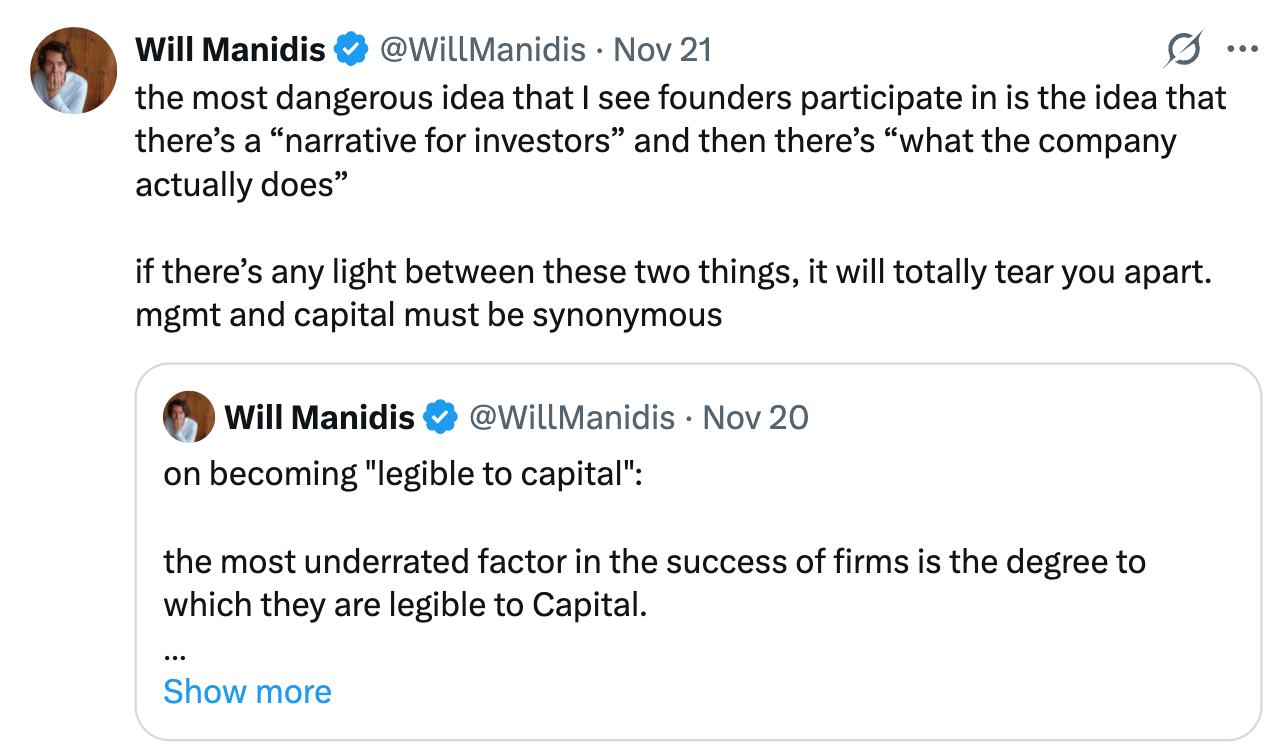
As Manidis says, a firm is legible to capital when “by dint of their existence capital forms behind them in excess.” But this only happens when the trade is clear. He uses the chocolate cake problem to explain this alignment. Many firms have great inputs like eggs and chocolate, but management thinks they are cooking a soufflé, investors think they are getting cupcakes, and talent thinks they are getting a pound cake.
The companies that are most legible to capital are obsessive about chasing the tolerances between competing ideas of the firm to zero.
This is the secret of the OKC Thunder. Presti, the coach/owners, and the players were all baking the exact same cake. They were willing to lose for years and accumulate assets in order to build a dynasty because there was zero tolerance for competing ideas.
Finding the OKC Thunder of AI Startups
So if we take this blueprint of hoarding talent assets, positionless systems, and extreme cultural alignment, and look for the OKC Thunder of the AI world, we first have to look past the teams buying championships.
We have to ignore the Lakers or Warriors of AI like OpenAI or Anthropic. They are massive and expensive and filled with veterans or researchers paid like NBA superstars. OpenAI now has over 3,500 employees and wins through brute force and luxury tax spending on compute.
We are looking for a team that wins with greater efficiency. When you look at the market through that lens, one company stands out, and it is Cursor.
They recently became the fastest software company in history to hit $1B in ARR (they got to $100M with zero marketing spend). While the establishment relies on a massive payroll, Cursor still operates with a tight rotation of roughly 250 people.
Here is why Cursor is the Thunder.
1. The Draft Strategy ←→ Hoarding Atomic Units
The Thunder didn’t build their core by signing free agents to fill specific roster holes. They didn’t say “we need a center.” They drafted unicorns which are long and high-IQ players who could do everything and figured the fit out later. They played the numbers game.
Cursor does the exact same thing. Most startups still hire certain roles. They need a senior react engineer or a product marketer. Based on inside notes from the Cursor team, they operate differently. They treat the atomic unit of hiring as the person rather than the role. They have a slack channel where they just drop names of people who are outliers.
It doesn’t matter if there is a role open. If the person is talented they swarm them. They chased one engineer, Lukas Möller, for a year after he rejected their first offer. They hired another, Ian Huang, just because he was coding into the wee hours of the night, and they saw it in the customer telemetry.
This mirrors the Presti approach of asset optionality. They aren’t trying to fill a hole in the org chart. They are hoarding talent density. This results in a team where 50 employees are former founders. That feels like the NBA equivalent of a roster full of lottery picks.
2. The Positionless System ←→ The House of ICs
Having talented players is one thing, but the system in which they play is another. The Thunder play a 5-out offense that requires constant motion and decision-making from everyone. It creates a pace that slower and more structured teams can’t match.
In software the slower structured team relies on the assembly line where product managers write specs, designers make mocks, and engineers simply execute. It is super rigid and slow.
Cursor operates as a House of ICs (Individual Contributors). They have effectively removed the layer of middle management, so there is no hand-off. The roadmap is bottoms-up and driven by the people actually writing the code.
Inside Cursor described a recent weekend where a group of four locked themselves in a room to ship a major browser feature. No permission, no spec document, just pure execution. They really have that 'you can just do things’ mentality.
This is the operational version of positionless basketball.” By removing the friction of management, they increase the pace of play. They acquire more possessions and iterations than their competitors.
3. Alignment: Raising the Ceiling
This brings us back to legibility to capital. What is the cake Cursor is baking?
Most AI startups are trying to lower the floor. They want to democratize coding so anyone can do it. That is a messy and crowded market.
Cursor made the trade clear because they are raising the ceiling. They are building a tool to enable the top 1% of developers to become 10 times faster. They are betting on high-agency users. Because of this clarity, there is no air between the founders, the team, and the investors. The trade is immensely clear, which is why capital ($3B of it) formed behind them instantly.
Closing Thoughts
The reason the OKC Thunder are terrifying to the rest of the NBA isn’t just that they are good now. They are set up to be good for the next decade. They have one of the youngest rosters and the most draft picks.
Cursor feels the same. They aren’t winning because of a single feature that can be copied. They are winning because they built a machine that is better at building the product than anyone else. They have assembled the best talent, eliminated management friction, and aligned everyone around a common goal.
That is a dynasty in the making.